IT’S ABOUT TIME – Learning tennis as an open-skill sport
There is an overwhelming amount of information out there regarding how to play tennis. The bulk of it is technical in nature, information about how to hit a ball. The challenge is that success in tennis is every bit as much about when to hit a shot as how to hit it. In other words, it’s about time (doing the right thing at the right time).
The reason is that tennis is classified as an open-skill sport by motor learning researchers, and specifically, as a ‘Perceptual Motor Skill’. These are skills where players must constantly adapt their movements to ever-changing, often unpredictable situations on the court. On every shot, a player is in a constant dance with the situation, which informs them where to move, what shots are available to respond with and where to recover. The player’s movement and stroke execution must be continually adapted to the situation at hand. Movements are ‘externally paced’ (What’s happening determines when movements are performed). Here is a quote that captures that concept from legendary player Rafa Nadal (do you think he knows what he is talking about?):
Every shot is different, every single shot. No ball arrives the same as another, no shot is identical.
Rafa Nadal: 22-time Grand Slam winner
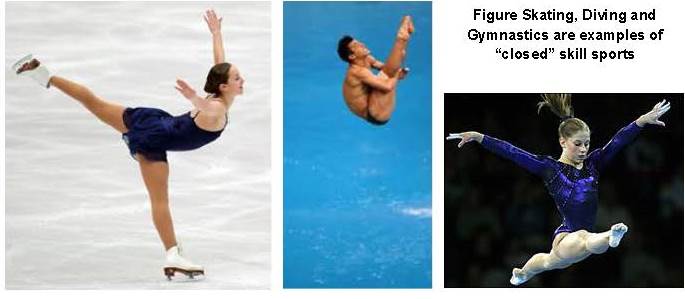
Contrast this to a closed-skill sport (such as diving, figure skating, gymnastics, etc.). Here, the objective is to execute often pre-determined movements in a precise and repeatable way, based on an idealized model or form, in a stable environment. Movements are ‘self-paced’ (the athlete decides when they are performed). In closed-skill sports, performing the movement correctly is how athletes gather points and win medals. Tennis matches, by contrast, are not won by amassing points from judges who sit at courtside, evaluating the form of each stroke.
A PROBLEM WITH TRADITIONAL TENNIS TEACHING?
For various reasons, tennis coaching has evolved over the years into coaching tennis as a
closed skill by making the priority of the lesson about conforming students to performing technical movements in a prescribed form.
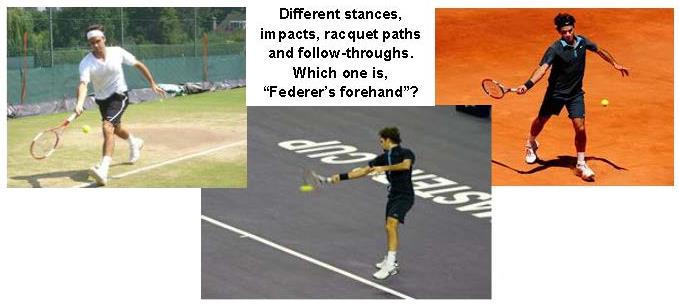
For example, when looking at the ‘forehand groundstroke’, a standard model will come to mind for most coaches and players. In recent years, the model’s content has been updated to reflect modern trends in the game (e.g., Semi-open stance, loop swing, Semi-western grip, etc.). This ‘model thinking’ has even continued through the technological revolution (e.g. slow-motion video of Federer’s “forehand”).
Even with all the research and information about learning out there, the approach of giving players technical models to copy is so pervasive that, in our coaching education, I light-heartedly classify it as a disease for coaches called “modelitis.” Do you suffer from a mild or severe case of modelitis? I have to admit that it is still so much a part of the coaching world that I even get sucked into the mindset occasionally.
These Modelitis lessons typically consisted of a coach standing at mid-court delivering a predictable feed to a student and harping about the elements of the ‘ perfect form’. Once the model stroke was reasonably stable, the coach sent the player back into the “real world”, expecting the player to successfully use the carefully-polished stroke in a live rally or match play situation. The typical result was the stroke quickly breaking down. Why? Because the player was not equipped to adapt it to real-play situations. After the breakdown, the player would return to the coach, only for the cycle to be repeated.
A model-based methodology impedes the development of open skills because it falsely conveys that there is a “one size fits all” technique that is good for every situation (e.g. “The basic forehand”). However, does the same technique occur if the forehand is performed from a wide ball or a 3/4 court low ball? Is it the same for an attacking shot or a defensive one? Is it the same when receiving a high ball or sending a sharp angle? When the ‘basic stroke’ must be changed constantly to adapt to the situation, it becomes the exception rather than the rule. So, why would it be considered ‘fundamental technique’?
For example, in observations of advanced beginners rallying (2.0 Play Tennis Rating), the ball was within range to perform the standard ‘model’ groundstrokes for a maximum of 30% of the time (it would be far less in an actual match). In other words, when novice players play (not drill), they are required to adapt in ways they have never been taught the majority of the time! It’s no wonder that many find tennis frustrating (especially after lessons).
True, many players eventually discover that stroke adaptation is critical to real-world tennis. But how long does it take to achieve a reasonable degree of success? Months? Years? We now know there is a much better and faster way.
OPEN SKILL LEARNING
In the 1980’s, Canadian Coach Louis Cayer began systemizing a method of instruction based on the principles of open skill development. The approach was so effective that Tennis Canada adopted it as the official national coaching methodology. Cayer later became the Davis Cup Captain and National Head Coach and is now recognized as the world’s top doubles coach, working for the British LTA. The International Tennis Federation and numerous countries have also adopted many of the principles.
In any open-skill sport, technique is not an end in itself as in closed-skill sports. In an open skill, the situation rules. The player must correctly perceive the tactical situation, which provides all the information needed to make the required decisions and take the necessary actions. Perception & action are intimately coupled.

Playing is all about decision-making. In my experience, 40-60% of all errors can be traced back to some decision-making deficiency. The player didn’t nail down when to do the appropriate shot. For example, a player practices a cartload of backhands. In the match, during a rally, the ball comes a little faster (or deeper, higher, wider, etc.), the player doesn’t adapt their stroke and decide what to do on time, resulting in an error. The majority of coaches, players (and parents) watching would chalk it down to a technical error (e.g. they hit late), but that was only an outward symptom of not seeing what was going on and doing what they needed to do at the right time. Is the solution to practice another bucket of balls to perfect hitting early, or is there something more? The goal should focus on creating functional, adaptive action solutions rather than following a fixed ‘motor program’.
In an open skill, technique is only a means to execute a tactic. The player must know what they are trying to do (intention) and when (attention), not just how to do it. Being ‘skillful’ involves selecting the appropriate invitation for action (called ‘affordances’ in the skill acquisition literature) from the many options available and performing it, rather than merely being able to robotically recreate a movement. Technique should never be divorced from tactics, no matter what the level of play. Indeed, no decision-making equals no skill, and a technique without a decision is simply a movement. Therefore, in open skill learning, it is more effective to speak in terms of tactical-technical training rather than dealing with technique on its own.
Since every shot involves this process, it is more effective to learn how to play (perform tactics with associated, functional technique) rather than teaching ‘proper technique’ first (the strokes) and then tactics later. This ‘You must learn the proper technique first’ approach is not learner-centred because the ‘proper technique’ must always be adapted in ways not taught, applied to situations only mentioned, with decision-making skills never trained.
WHAT ABOUT REPETITION?
Repetition is required for any sport; however, when the repetitions include problem-solving, perception and decision-making, they are worth far more in terms of learning than basket feeding a stroke isolated from reality with the hope of plugging it in later. In the motor learning literature, this is called ‘Repetition without repetition’. Don’t misunderstand, basket feeding can be a valuable tool in specific circumstances, but it should not be used to learn actions decoupled from their reality.
CONCLUSION
The goal of this information is to help coaches ensure that their training effectively transfers to match-play. Effective tactical-technical learning must involve players reading the situation, making good decisions about when to perform the functional technique and, just as importantly, when not to do it or when to adjust it. Open skill learning maximizes the transfer between the practice court and the match (not just repeating how to stroke balls). We need to develop players, not strokers.
Check out the many articles on acecoach.com to find tools and resources for coaching using this approach.
Very useful and interesting article.
Furthermore, i think only the serve probably should have a Biomechanic model because it’s in the limit of closed skill and the movement of serve don’t need any adaptation or modification in this context.
What’s you point of view regarding that Mr Wayne.
Regards,
Hichem,
Thanks for the comment. Great that you are thinking about these things.
Serve is more ‘closed’ than say groundstroke rallies but, not fully closed. It has ‘closed’ reception (unless your toss is really bad) but open projection options. When you say ‘doesn’t need adaptation or modification’, I would point out that there needs to be adaptation for 1st Serve vs 2nd Serve, Ad side isn’t exactly the same as Deuce side, you must adapt to send it wide, at the body or down the center, technical changes have to occur to send it flat, with topspin or slice. In other words, 36 modifications that need to be made otherwise your serve will not be successful for the situation and tactical intentions.
I am not fond of biomechanical ‘models’ but, am fully on board with applying biomechanical principles to all of those 36 modifications to make them all effective and efficient.
Dear Wayne,
Thank your for your clear feedback.
Noted that.
Wish you all the best.
Regards,
Hichem
is there research out there that looks at the effectiveness of training open skills (like tennis) in a closed skill manner? Ie actually proves that open skills should be introduced in a closed way and this is the best approach for beginners?
Really good question Tom. There is no research I am aware of, as the two methods are a little bit like oil and water and don’t mix well. They come from two completely different starting premises. So, the research tends to focus on comparing starting and ending with the same approach. I have had coaches express that they feel compelled to start with closed skill training but usually, it s only because that is the only method they are familiar with and they can’t fathom how it even could be done in a different way. All I can say from experience doing it all closed, all open, starting closed and going open, and starting open and going closed is, consistently using an open skill methodology from beginning to end yeilds the most effective results.