
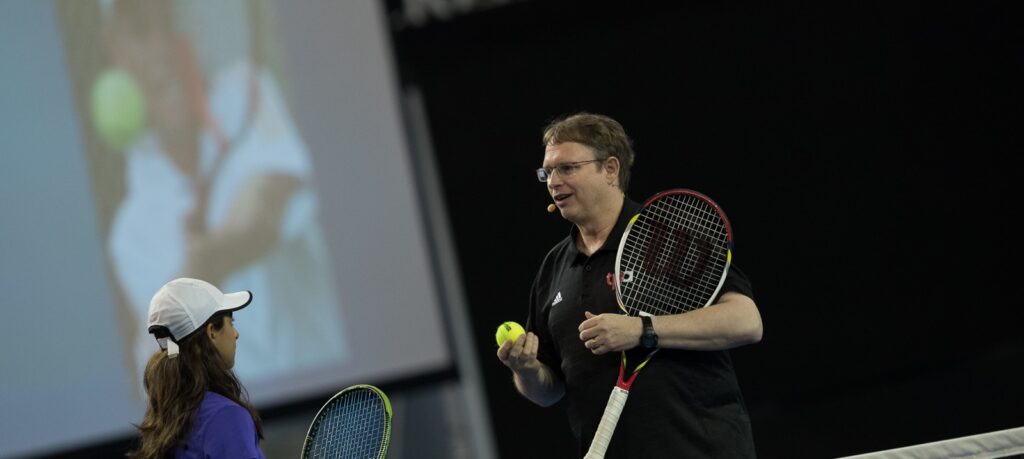
Photo credit: Front Row Studios -2017 Australian Open Grand Slam Coaches Conference
WHAT IS ‘DIRECT PERCEPTION’ AND WHAT DOES IT MEAN FOR COACHES?
Watching professional tennis matches is always awe-inspiring. Players are so skilled, it often looks deceptively easy. There are the obvious physical skills of athleticism, but there are also what are referred to as ‘unseen skills’. These are what distinguish players as successful performers (at every age and level).
In this series, we will look at a number of these tennis superpowers, which include:
- Problem solving
- Perception
- Decision-making
- Technical Adaptability
- Performing under pressure
Although every coach wants their players to have these abilities, the typical practice design often ignores or even hinders their development.
A CHANGE IN VIEWPOINT
Several years ago, I started a journey that has changed my view of skill acquisition. In the last few years, it has all come together to the point that I have realized the Ecological Dynamics (ED) paradigm provides a much more effective framework on which to base all my coaching. (I will eventually be updating all my material on acecoach.com accordingly.) (For an introductory article on ED, click here)
There is a lot of great work on ED by Professor Rob Gray of Arizona State University (and one of the ‘fathers’ of ED), and I have found some good tennis applications from UK coach Steve Whelan. I recommend looking up anything they’ve done.
SKILLS VERSUS TECHNIQUE
We need to start by understanding the difference between coaching technique and coaching skills. Coaches typically spend the majority of their time teaching technique (which, in most cases, means perfecting a motor pattern that can be repeated when needed). In contrast, we need to see it more as coaching skills.
DIRECT PERCEPTION
One of the main differences between my previous views and the ED view is the way I formerly viewed perception. Previously, perception for me was a ‘step’ in the information processing (IP) process.
To develop skillful adaptability, it is important to understand Direct Perception and that all the information we need is contained in the environment. We simply need to connect to it appropriately.
In ED, this is a critical and core concept called ‘Perception-action coupling’. We perceive to move, but at the same time, we also move to perceive. Our perception and action form an ongoing feedback loop, with perception guiding action and our actions guiding perception.
Perception and action are not sequential but simultaneous and interdependent. Therefore, tennis training needs to be about helping players learn to ‘attune’ to the relevant information and maintain their connection to it rather than memorizing movements and technical positions (E.g. the ‘ideal’ position to take on a FH groundstroke backswing).
COACHING IMPLICATIONS
So, what does all this ED-jargon mean for the coach on the court? How do we train this perception-action coupling to nurture this ‘Direct Perception’? Here are a few of the guidelines I have found helpful in the journey:
–Prioritize training skills, not ‘technique’
–Train skills by educating ‘Intention’
–Prioritize training ‘Attention’
–Prioritize variability for receiving the ball
–Keep practice activities ‘information-rich’
SUMMARY
The article discusses the concept of “Direct Perception” within the Ecological Dynamics framework and its relevance to tennis coaching. It distinguishes between coaching technique and coaching skills, emphasizing that skills involve adapting to environmental information to solve problems rather than repeating fixed motor patterns. The article explains how perception and action are coupled in a continuous feedback loop, where players perceive affordances in their environment and adjust their movements accordingly.
It advocates for training that focuses on skill development, intention, attention, and variability in practice, rather than rote technical drills. Practical coaching strategies include educating players on intention, improving visual tracking, and designing information-rich, game-like practice scenarios to enhance players’ ability to attune to relevant information and make timely decisions on the court
Leave a Reply