
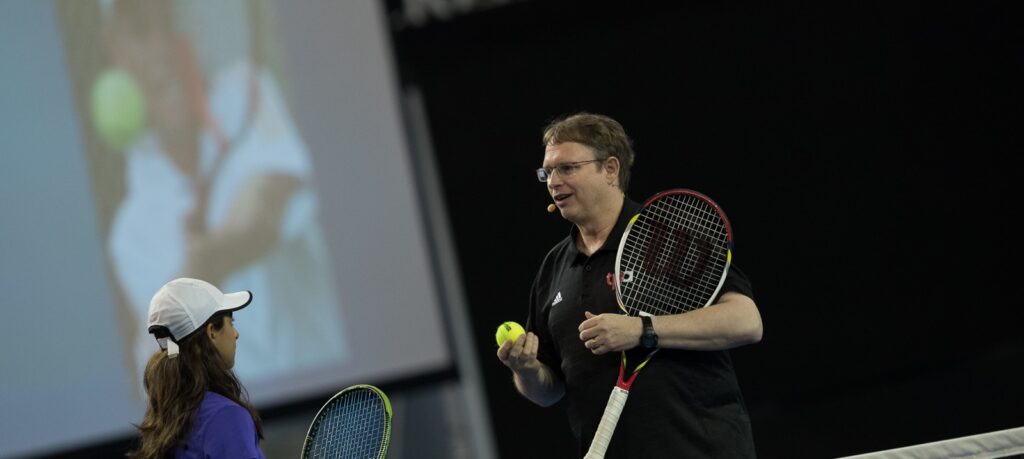
Photo credit: Front Row Studios -2017 Australian Open Grand Slam Coaches Conference
CAN AN ECOLOGICAL DYNAMICS APPROACH HELP DEVELOP DECISION-MAKING AND TECHNICAL ADAPTABILITY?
Professional tennis matches are awe-inspiring to watch. They are a showcase of exceptional skills. However, it is not the obvious athletic skills that are the only highlight, but also the ‘unseen skills’. These are what distinguish players as successful performers (at every age and level).
In this series, we will look at a number of these tennis ‘superpowers’, which include:
- Problem solving
- Perception
- Decision-making
- Technical Adaptability
- Performing under pressure
Although every coach wants their players to have these abilities, the typical way they design their practices often ignores or even hinders their development.
The main reason for my leaning into ED is the concept of ‘transfer of learning’. Every coach has felt the frustration of spending time training things that players end up not using in matches.
It is not that coaches do not get players to do what they are supposed to in practice. It is that the training is not transferring to match play. A lack of transfer is often due to a lack of decision-making and technical adaptability. In my opinion, ED provides a significant key to unlocking why poor transfer occurs and how to alleviate it.
The term ‘Decision-making’ is a little misleading. It gives the impression that it is a cognitive process of taking in all the variables, having your brain weigh the options, and making a final, reasoned selection to take action. This is how I previously approached decision-making; however, my view changed when I researched what the current research shows.
AFFORDANCES – DOORWAY INTO DECISION-MAKING
One cannot talk about decision-making in an ED approach without reviewing the concept of ‘affordances’. In simple terms, these are: ‘Action possibilities offered by the environment’.
These possibilities emerge from the relationship between the environment (the court, the opponent, the ball, etc.) and the player. For example, a ball received head-high at net ‘affords’ the possibility of a powerful shot (in contrast to what is ‘afforded’ by a low ball).
The concept of affordances changes the way ED views decision-making, not as a ‘mechanistic’, brain-controls-the-body process. Rather, it is an ‘embodied’ (ED-speak for our mind/body system working interconnectedly) response to an affordance, based on the unfolding information of the environment/situation.
Duarte Araújo, the director of the Laboratory of Expertise in Sport of the Faculty of Human Kinetics at University of Lisbon, Portugal puts it this way:
“The action IS the decision. Perception, decision-making and action are not separate stages.”
TECHNICAL ADAPTABILITY
This is where technical adaptability factors into our discussion. Decision-making and technical adaptability are two facets of the same process. Technical adaptation is the face of decision-making and therefore, the main priority of technique.
Even if a player has a good tactical intention, the accompanying technical decision/action is predicated on the affordances that become available based on the reception of the ball.
Every slight variation requires the body/mind system to change course and adapt. For example, even with the intention of making the opponent move, receiving a higher/deeper ball makes a drop shot a poor choice. Receiving a faster/wider ball makes a down-the-line drive very risky, etc.
COACHING IMPLICATIONS
Poor decision-making can result from poor practice design. Teaching players ‘proper technique’ through repetitive feeding drills may contribute to why so many players lack decision-making skills and adaptability. In other words, the way coaches train their players may have actually created their own problem.
Transfer occurs by practice providing many experiences for players to find multiple movement solutions to problems. For example, learning ‘slicing’ on groundstrokes by playing a slice-only game in the service boxes rather than feeding balls and prescribing a pre-programmed slice technique.
As UK coach Steve Whelan observes, ‘One is trying to teach a movement while the other is shaping the information they interact with so different coordination patterns can emerge’
SUMMARY
An Ecological Dynamics (ED) approach can enhance tennis players’ decision-making and technical adaptability—two “superpowers” essential for effective match play. It argues that traditional coaching often fails to transfer skills from practice to competition because it emphasizes rigid technique over adaptable skills.
ED reframes decision-making as an embodied process of perceiving and acting on “affordances” (action possibilities offered by the environment), guided by tactical intention, while technical adaptability enables players to adjust movements to ever-changing situations.
Leave a Reply